Preview

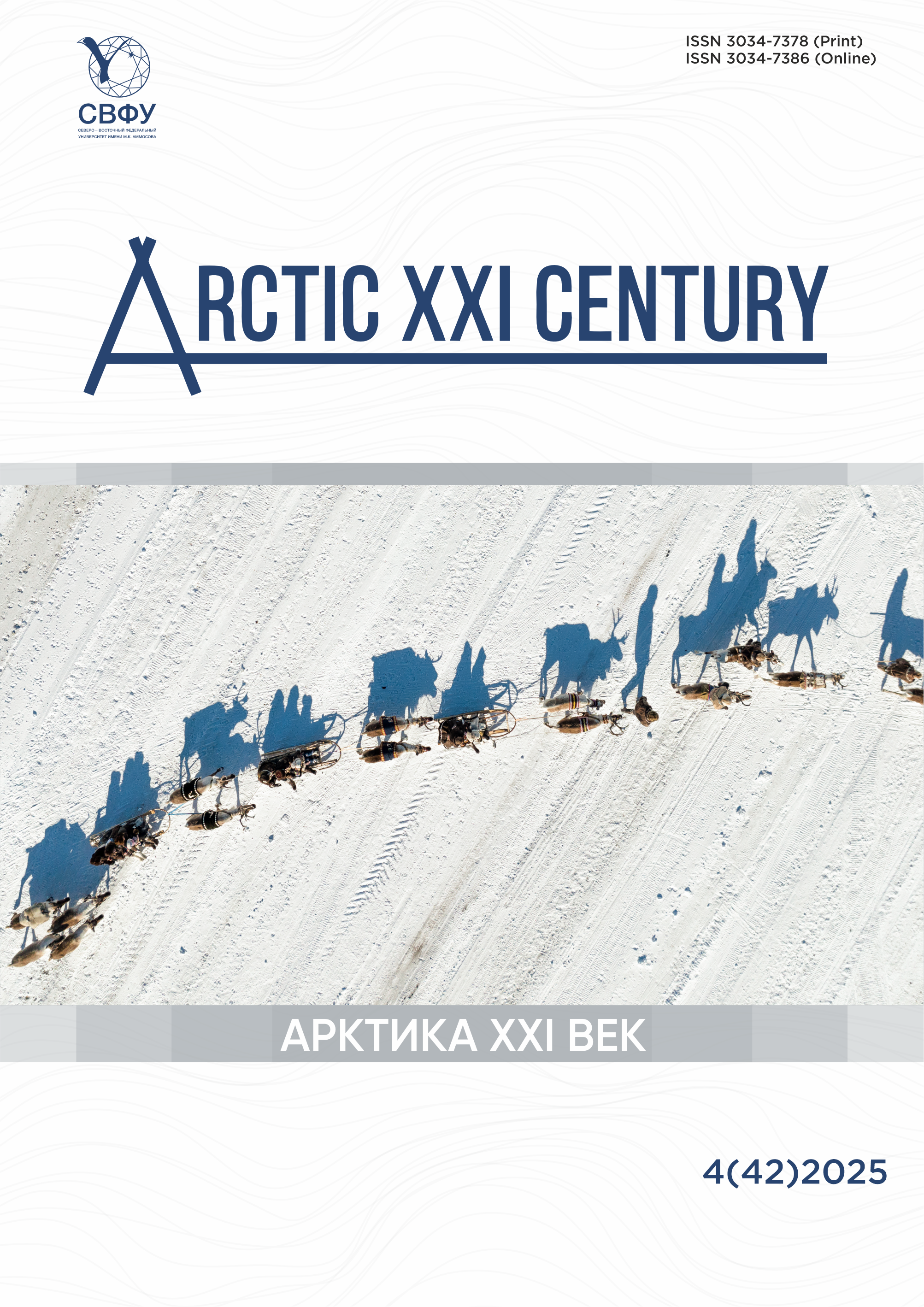
Arctic XXI century

Advanced search

Arctic XXI Century is a peer-reviewed periodical focusing on current issues in the study of languages of the peoples of the North and the Arctic. The Journal publishes high‑quality original research reflecting contemporary trends in linguistics and related disciplines.

ISSN: 3034-7378 (Print), 3034-7386 (Online)

The Journal's mission is to promote and advance scholarly research while spotlighting significant global progress in the revitalization, preservation, and development of Northern and Arctic Indigenous languages.

Editor-in-chief: Ninel V. Malysheva

Publisher and founder: M.K. Ammosov North-Eastern Federal University, Yakutsk, Russia.

Until September 16, 2024, the journal was published under the title "Arctic XXI Century. Humanitarian sciences". Certificate of registration PI No. FS77-88190 dated September 16, 2024.

CURRENT EDITORIAL POLICY AND SCOPE

In 2025, the Journal underwent a comprehensive review of its core concept and thematic scope. The journal now publishes cutting‑edge findings from interdisciplinary research conducted by scholars in Russia and abroad. Its scope covers a wide array of fields, including historical linguistics, linguistic paleontology, ecolinguistics, sociolinguistics, anthropological linguistics, cognitive linguistics, onomasiology, linguistic geography, and other related disciplines.

Note: The Journal's editorial board has been fully renewed.

TARGET AUDIENCE

The journal serves researchers, university professors, postgraduate students (PhD candidates), master's students, and scholars pursuing doctoral (Dr. hab.) and candidate of sciences (PhD) degrees, as well as the broader Russian and international scientific community in linguistics, ethnology, and Arctic Indigenous studies.

INDEXING AND ACCESS

Indexed in the Russian Index of Science Citation (RISC) since 2014.

Full‑text versions are available in the Scientific Electronic Library (eLIBRARY.RU) and the open repository "CyberLeninka" (CyberLeninka.ru) since 2016.

Listed in the database of the Norwegian Centre for Research Data (NSD) since 2016 (the NSD serves as Norway's equivalent to the Higher Attestation Commission).

The journal adheres to Open Science principles. Full‑text articles of the online edition are freely accessible on the Journal's official website, as well as in the aforementioned electronic libraries.

PUBLICATION FORMAT AND DISTRIBUTION

Publication frequency: 4 times a year.

Release schedule:

  • № 1 – the end of March
  • № 2 – the end of June
  • № 3 – the end of September
  • № 4 – the end of December

Publication form: printed and online editions

Territory of distribution: Russian Federation, foreign countries (international journal).

Website: https://www.arcticjournal.ru

Current issue

No 2 (2026)
View or download the full issue PDF (Russian)
5-21 167
Abstract

The article describes and analyzes the comparative meaning of the polysemantic lexeme olchaan ‘exactly the same as’, ‘just like’ in the Tuvan language. The research methodology is based on the semantic approach to the comparative description of comparative constructions in the Ural-Altaic languages of Siberia, developed at the Institute of Philology of the SB RAS. This approach distinguishes between the content plane (comparata, parameter base, parameter aspect, exponent, relation) and the expression plane. The material includes selection of examples from fiction and folklore texts, as well as the author’s subjective observations of Tuvan colloquial speech. It has been established that olchaan expresses similative relations, indicating the maximum degree of similarity. This lexeme can function as an adverbial modifier, an attribute, and, most characteristically, as a nominal predicate. As a present-tense predicate, olchaan does not take person-number affixes but combines with the evidential affirmative particle -tyr and the auxiliary verb bol- ‘to be, to become’ to express tense forms. Two main types of constructions are identified: with an explicit and implicit basis for the comparative parameter. Constructions with this word are characterized by a high degree of contextual dependence, regularly realized in the ellipsis of the object of comparison. The lexeme kara ‘black’, as a semantic intensifier, gives the comparison an expressive nuance. The word olchaan occupies a special place in the system of comparative means in the Tuvan language, combining the functions of a comparison marker and a predicate, and participates in the formation of the figurativeness of an utterance.

22-35 157
Abstract

The article examines the literary and educational potential of the tales about Ememkut, recorded by I. T. Barannikov, in the context of teaching Koryak literature. The relevance of the study is determined by the need to preserve the linguistic and cultural heritage of the Koryak people, strengthen the ethno-cultural component of education, and identify materials that support the formation of value orientations through native literature. The aim of the study is to identify the value content of the fairy-tale cycle about Ememkut and to analyze methodological approaches to its interpretation in school literary education. The research material includes tales about Ememkut, scholarly works on Koryak folklore, language and culture, and teaching materials on Koryak language and literature. The study employs culturalhistorical, ethnophilological, contextual, and methodological approaches, which make it possible to consider the tales both as literary texts and as sources of ethnocultural information reflecting traditional behavioral models. The analysis shows that the image of Ememkut embodies key norms and values: respect for elders, family responsibility, loyalty, mutual assistance, diligence, caution in relations with the natural and supernatural world, and condemnation of greed, frivolity, and violations of prohibitions. The most productive teaching forms include a biographybased lesson, analytical and problem-value discussion, role-reading, dramatization, bilingual text work, mind maps, and project assignments. The tales about Ememkut are therefore interpreted as a resource for literary analysis, ethno-cultural education, and value-oriented teaching.

36-53 132
Abstract

The article examines the role of material objects in human-animal interactions. The text analyses the use of landscape and various structures and devices in the process of reindeer domestication. Evenki structures serve more than just practical tools for performing everyday tasks. State organisations implemented various domestication regimes. Evenki reindeer herders mastered new material forms and adapted them for their own purposes. They developed specific strategies that include the use of small architectural forms such as tripods and other structures to protect animals from fire, fences sheds, feeders. Various structures and landscape features can be used both to restrict and to rationalize movement. They are not necessarily concentrated in one specific location and can be dispersed over a large area. Both buildings and landscape play a significant role in human-animal interaction. The article discusses the trilingual reindeer herding terminology used by Evenkis, which allows for the rapid localization of specific actions, as well as the tracking and memorization of animal movements. Domestication is not a distant past event, but a unique form of relationship between people, animals, landscape, and material objects, each component of which is essential to the ongoing reproduction of these relationships. At the same time, the landscape, small and large-scale architectural forms, and the array of objects used by reindeer herders in their everyday practices represent the material expression of these relationships.

54-73 186
Abstract

The article examines the perceptual lexicon of the Yakut language within an ecosemiotic framework. The relevance of the study is determined by the need to reveal how the sensory priorities of Arctic peoples, shaped by extreme natural conditions, are reflected in language and contribute to the preservation of linguistic heritage. The aim of the research is to reconstruct the hierarchy of sensory modalities encoded in the Yakut lexical system and interpret it as a reflection of historically formed adaptive strategies. The material includes explanatory and bilingual dictionaries of the Yakut language and illustrative examples from literary texts, comprising 327 lexical units. The methodology combines cognitive-semiotic modeling with component, distributional, and quantitative analysis. The results show a stable hierarchy of sensory priorities: hearing occupies the dominant position (31%) due to the semantic syncretism of the verb ihit ‘to hear – to understand – to obey’; olfaction ranks second (24%) and is marked by object-oriented and evaluative vocabulary; vision and taste hold intermediate positions (17% each), while touch has the lowest share (11%) and performs mainly auxiliary functions. The study also reveals an uneven distribution of subject-oriented and object-oriented lexicon, especially in the olfactory domain, where object-oriented encoding prevails (55%). The conclusion is that the dominance of hearing and smell reflects the ecological and social adaptation of the Yakut ethnos to Arctic conditions.

74-85 120
Abstract

The article examines the mythological conceptions of the wind among the Karelians based on the analysis of disease denominations attributed to this element and the corresponding healing practices in traditional culture. The aim of the study is to identify and systematize these conceptions. The empirical basis comprises lexicographic sources, field records, and folklore texts in the Karelian language. The study employs an interdisciplinary approach based on a comparative analysis of linguistic and ethnographic data, which enables the correlation of linguistic facts with ethnographic evidence. A comparative analysis is conducted across related (Vepsian, Finnish) and genetically unrelated (Russian) languages, all belonging to the same geographical and cultural area. In Karelian, the polysemous lexeme tuuli denotes wind, direction, disease from wind, and mood. Diseases attributed to the wind are two component lexemes: first part ‘wind’, second encodes causation, e.g., muahine (eczema from earth, with abscesses) and nenä (mystical disease with cough, headache). It is demonstrated that the wind is personified in the Karelian worldview and endowed with both destructive and healing powers. Among the Karelians and other Baltic-Finnic tribes, three elements – water, forest, and wind – are most deeply woven into the mythological fabric of everyday life. According to traditional beliefs, the wind was perceived as a living entity endowed with healing and destructive powers, having daughters, sons, labourers, and servants: tuulen poijat ‘sons of the wind’, tuulen tyttäret ‘daughters of the wind’, tuulen kazakat ‘labourers of the wind’, and tuulen käskyläzet ‘servants of the wind’.  Treatment used incantations addressing the wind as master (tuulen ižändy), mistress (tuulen emändät), beloved breeze (armahane tuvlut), and familiar breeze (tutavane tuvlut), often with ritual manipulations to drive away the malady. The findings indicate that the conceptions of the wind as both a source of illness and a means of healing constitute a stable component of traditional Karelian culture, shared with neighbouring peoples; the results are relevant for safeguarding the intangible cultural heritage of Finno-Ugric peoples.

86-117 129
Abstract
Abstract

This article presents a comparative analysis of motivational features of oikonyms (settlement names) in the Republic of Sakha (Yakutia) and three Canadian territories – the province of Alberta, the Northwest Territories, and the territory of Nunavut. The selection of these regions is justified by their climatic similarity, vast areas with low population density, and the presence of indigenous peoples with traditional subsistence economies. The study is based on an analysis of 36 oikonyms from Yakutia and 36 from Canada, employing descriptive, comparative-historical, etymological, and quantitative methods. The research examines both universal features shared by the oikonymic systems of both regions – such as multi-layered toponymic stratigraphy, toponymic irradiation, connection with geographical realities, and commemorativeness – as well as region-specific characteristics, including the predominance of indigenous linguistic strata in Yakutia and the active revitalization of native place names in Canada, ideologically marked Soviet oikonyms in Yakutia, and anthropotoponyms associated with the missionary and colonial history of Canada. Special attention is paid to the analysis of semantic groups of oikonyms reflecting physiographic characteristics, economic activities, and ethnocultural contacts. The cross-continental comparison of toponymic material reveals both deep universal patterns of naming and unique regional strategies of settlement designation, reflecting the ethnocultural history and the specific ways in which the peoples of the Arctic and the North have appropriated and conceptualized their spatial environment. The findings contribute to the development of comparative toponymics and linguoculturology, expanding the understanding of the mechanisms of toponymic nomination in polyethnic regions of the world. The study also demonstrates how historical and cultural processes, including colonization and decolonization, shape the toponymic landscape and influence the identity of local communities.

118-142 143
Abstract

The article examines climate-related transformations in Arctic communities living in areas of continuous permafrost. The relevance of the study is determined by the accelerated warming of the Arctic and the need to understand not only environmental and economic, but also linguocultural consequences of climate change. The aim of the research is to analyze five key problems: changes in the water regime of rivers and lakes, permafrost degradation, weather instability, shifts in species ranges, and changes in seasonal timing, as well as local adaptation strategies in the Sakha Republic (Yakutia) and Alaska. The methodology is based on an interdisciplinary approach combining linguoecology, the anthropology of cold, and linguistic landscape analysis. The empirical material includes the authors’ field data collected in 2009–2025: interviews, sociological surveys, and municipal archive records, processed through content analysis and thematic coding. The results show that local communities use both traditional adaptation practices, including hay drying on wooden poles and draining water from thermokarst lakes, and technological solutions, such as adjustable steel piles in Alaska and village relocation to nonfloodable areas in Yakutia. It is shown that climate instability causes compression of the linguocultural landscape: the loss of precise nature-related vocabulary, the deactualization of calendar signs and paremias, and the weakening of links between traditional economic terminology and real seasonal phenomena. The conclusion emphasizes the need to include linguocultural monitoring in Arctic sustainable development strategies and to document vanishing traditional ecological knowledge.